Wednesday, August 3, 2016

Fixing Most (Not All) IE11 Compatibility Problems

In earlier Internet Explorer versions, Microsoft smartly placed the Compatibility Viewicon directly at the end of the Address bar, as shown, allowing you to quickly alter how IE displayed the web site.

But, in IE11 there is no longer a convenient button to switch modes. Instead, you'll need to pull up the Compatibility View Settings list and add the offending site. Funny enough, Google.com is one of the sites I had to add to the list, just so I can view Google+ correctly.
To get to the Compatibility View Settings list, do this:
1. At the top-right of IE11, click or tap the cog wheel to drop-down the Tools menu.
2. Choose Compatibility View settings from the menu. This brings up the Change Compatibility View Settings options.

3. Add the poorly displaying or seemingly broken web site to the list.
After you add the web site to the list, Internet Explorer will refresh the page you are visiting and you'll then be able to test if the compatibility problem is fixed.

How to downgrade from IE 11 to lower versions of IE's in Windows 7?

This is a step-by-step tutorial guide that help you achieve the task of installing a lower version of IE on Windows 7.

1. Go to Programs and Features, by searching it using the start button.


2. In the Program and Features windows, click on Turn on Windows Features on or off link (as shown in blue circle).


3.  A Windows Features windows will show, uncheck the Internet Explorer 11 (as circled).


4. You will get a message prompt as follows,  select Yes.


5. Select View installed update link (as circled)


6. Type in Internet Explorer in the search box, you should get the Internet Explorer 11 in the list


7. Right click the Internet Explorer 11, and click Uninstall

8. It will prompt you to restart the computer, choose Restart now.


9. After restarting, you can check your browser version, by click the About Internet Explorer in the internet explorer.


9. For mine, I see this:


9. If my aim is  IE 10, I have done. But say I wish to go for IE 9, repeat the same process from steps 1, 5, and 6, to come to the following windows, now we remove Windows Internet Explorer 10. (If you have problem finding Windows Internet Explorer 10 here, you should repeat the steps 2, 3 and 4 for IE 10).


10. That's it, after remove IE 10, you should be able to install IE 9 :)

Install the print driver with the Add a Printer wizard

Install the built-in print driver over a wireless or wired (Ethernet) network connection on a computer with Windows 7 or Windows Vista.
  1. Search Windows for devices, and then click Devices and Printers in the list of results.
  2. Click Add a printer.
    Figure : Clicking Add a printer
    Clicking Add a printer
  3. Select Add a network, wireless or Bluetooth printer.
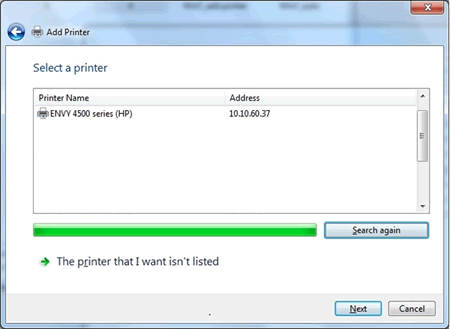
    Select a printer windows displays.
    Figure : Example of a printer found in Select a printer window
    Example of a printer found in Select a printer window
    • If your printer is in the list, select it, click Next, and then follow the on-screen instructions to install the driver. You can now use your printer.
    • If your printer is not in the list, click the back arrow in the upper left corner of the window to return to the What type of printer do you want to install? step, and then continue to the next step.
  4. Click Add a local printer.
  5. Select Use an existing port (LPT1: Printer Port), and then click Next.
  6. Click Windows Update, and then wait for the print drivers to update.
  7. Click HPHewlett-Packard, or Hewlett Packard in the Manufacturer pane, and then click the name of your printer in the Printers pane.
    • If your printer is in the list, select it, click Next, and then follow the on-screen instructions to install the driver. You can now use your printer.
    • If your printer is not in the list, click the back arrow in the upper left corner of the window two times to return to the What type of printer do you want to install? step, and then continue to the next step.
  8. Click Add a network, wireless or Bluetooth printer window, and then click The printer that I want isn't listed.
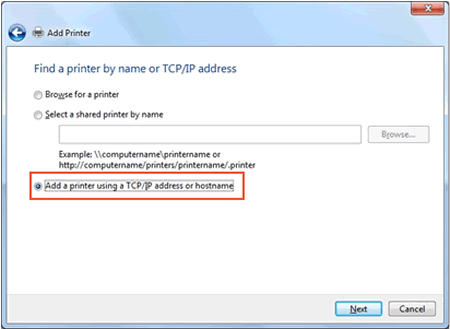
  9. Select Add a printer using TCP/IP address or hostname, and then click Next.
    Figure : Selecting Add a printer using TCP/IP address or hostname
    Selecting Add a printer using TCP/IP address or hostname
  10. Select Autodetect from the Device type drop-down list.
    Figure : Selecting Autodetect
    Selecting Autodetect
  11. Type your printer IP address into the text box, and then click Next.
    You can find the IP address by printing either a Wireless Network Test report or a Network Configuration page. For printers with displays, the IP address displays on the printer control panel through the wireless  icon or button.
  12. Wait for the computer to connect to the printer, and then click Next to install the print driver.

Reverting to a Previous Version of Java for Windows

Step 1: Uninstall current version of Java

  1. Access the Control Panel:
    • In Windows 7 (see left-hand image below), select the Windows button, then select Control Panel.
    • In Windows 8, 8.1, and 10 (see right-hand image below), right-click in the bottom left corner of the screen, then select Control Panel.
  2. Select Programs and Features.
  3. In the list of programs, select the undesired version of Java, then click Uninstall. (If you have multiple versions of Java installed, you may want to uninstall all of them.)

Step 2: Install desired version of Java

  1. Go to Oracle's Java SE 8 Archive Downloads page and locate the desired version of Java.
    • Example: If you want to install Java 8 Update 60, find the box labeled Java SE Runtime Environment 8u60.
    • If you have questions about which version of Java to install, please contact the Technology Service Desk.
  2. In the gray box, select Accept License Agreement. Then, in the Product list, locate the option(s) labeled Windows x86 Offline, then select the.exe file option.
    • Example: For Java 8 Update 60, select the jre-8u60-windows-i586.exe file.
  3. After clicking the download link, you will be prompted to sign in with an Oracle Account. If you don't already have an Oracle account, you can create an account by clicking the Create Account button on the right. After you fill out the required information, a confirmation email will be sent to the email address you entered.
  4. Once you're logged in, the download will occur immediately after following the link.
  5. Once the download has finished, click on the downloaded file and install the desired version of Java 8.

How To Remove Internet Explorer From Windows?

Internet Explorer Cannot Be Found In Programs And Features

We noticed that entry to uninstall Internet Explorer cannot be found by going to "Control Panel -> Programs -> Programs and Features". There you will find all the programs installed in Windows, except Internet Explorer.
Internet Explorer, Windows 7, Windows 8.1, remove, uninstall
That's because, after the latest versions of Windows and Internet Explorer were made available, Microsoft started to classify this browser as a Windows Feature.

How To Remove Internet Explorer From Windows

First, go to "Control Panel -> Programs -> Programs and Features". Then, in the column on the left, click or tap "Turn Windows features on or off".
Internet Explorer, Windows 7, Windows 8.1, remove, uninstall
In the Windows Features window, scroll down until you find the entry for Internet Explorer. Uncheck it and press OK.
Internet Explorer, Windows 7, Windows 8.1, remove, uninstall
You are warned that: "Turning off Internet Explorer might affect other Windows features and programs installed on your computer, including default settings". Click or tap Yes, to continue.
Internet Explorer, Windows 7, Windows 8.1, remove, uninstall
You are back to the Windows Features window, where the entry for Internet Explorer is unchecked. Press OK.
Windows takes a while to make the necessary changes.
Internet Explorer, Windows 7, Windows 8.1, remove, uninstall
When done, you are informed that Windows needs to reboot your PC. Close any unsaved work and click or tap Restart now.
Internet Explorer, Windows 7, Windows 8.1, remove, uninstall
When you log back into Windows, Internet Explorer is removed.

Tuesday, August 2, 2016

10 Tricks To Fix Google Chrome Not Responding Issue

10 Tricks To Fix Google Chrome Not Responding Issue

Trick 1 . Browser Optimization

Sometimes your browser optimization is more than enough to fix the chrome not responding problem. Open Google chrome, clear the cache, browsing history and cookies.
  • Open menu ( top right corner)
  • Click, “More Tools > Clear Browsing Data” or use the short cut “Ctrl+Shift+Del”
  • In the upcoming window, leaving the options, passwords and content licenses, check all other boxes as shown below.
  • Click clear browsing data.
Now re-launch the browser and check whether you get the same error again.

Trick 2: Cookie Clean Up

Whenever you visit a new website, it leaves a small piece of data called cookies with your web browser. It will record your preferences, browsing history and the like info. When you visit the same website in future, this file will be used to remember who you are and what you saw in that website etc. (Side note: This is how websites like ebay, amazon show ads as per your previous view, purchasing history).
Though cookie files will not consume much of the memory, what if you visit 100 sites per day? You don’t really need to keep cookies from every website you visit. Every additional KB you add up with the “Temporary memory” will slow down your system. By default, Google chrome allows cookies from all website. But you can control this settings.
  • Open menu
  • Click “Settings->show advanced settings
  • google chrome not responding
  • Expand the “Privacy Section” and Click “Content settings”
  • You will get the window as shown below
  • Change the settings as per your preferences and click on “All cookies and site data“.
This will show all the cookies and data stored in your browser. Click remove all -> done.

Trick 3 : Close the non responsive window

When you open more than one tab in Google chrome, chances are one or few tabs will get frozen. At times, closing only the non responsive tabs will fix the issue.
  • To do this open chrome’s task manager. You can do this by pressing the keys“Shift+Esc”
  • You will get a window showing all the running processes and extensions.
  • Choose the frozen tab or tabs and hit end process.

Trick 4 : Disable the Extensions

Sometimes malfunction of third party plug-in(s) can trigger the Google chrome not responding error. Try disabling all the third party extensions and re activate it one by one and check the browser. It will help you identify the plug-in which causes the incompatibility issues. Spot that one and disable it permanently. Hopefully, it will fix the issue.
  • Open Menu
  • Click Tools->Extensions.
It will show you all the extensions installed in your browser.

Trick 5 : Bad Proxies Might Be The Culprit

If you break your head with why is my Google chrome not working, check the proxy settings. Incorrect proxy settings might cause this issue.
  • Open menu
  • Navigate to settings->advanced settings.
  • Click “change proxy settings” under the label Network
  • In the upcoming window click “connections” Tab and click “LAN Settings”.
  • Ensure the check box named “Automatically detect settings”, is checked.
Generally, you don’t need to do anything with proxy settings. If you use external proxies in your browser, verify the data entered under the manual proxy settings are correct.

Trick 6 : Turn Off The Sandbox Mode

  • Sandbox mode security feature can make your chrome go not responding. Try disabling this feature and check whether the problem persist.
  •  Right click on the Google chrome short cut (In Desktop).
  • Select “Properties” and navigate to the tab “Shorcut”.
  • Append the string “-no-sandbox-” at the end of target field.
  • Google chrome not responding
  • Click ok.

Trick 7 : Run A Virus Check 

Malware and virus programs can corrupt our files beyond repairable. It is same with the browsers as well. Scan your system with up-to-date antivirus program and keep your system clean. Doing this alone will solve 80% of your system issues.

Trick 8 : Fix Your Flash

When working with Google chrome, almost all of us encounter the pop up, asking us to choose between “Wait / Kill pages”. It happens due to the conflict that occur between the Chrome’s internal Flash module and Adobe flash plug-in. When both are enabled, Instead of choosing any one, Chrome tries to use both and finally ends up with a browser crash. To avoid this issue, enable anyone of the flash version.
  • Enter the term “Chrome://plugins” in the chrome address bar without the quotes.
  • google chrome not working
  • From the displayed plug-ins list, spot the plug-in “Adobe Flash Player”.
  • If adobe flash player is enabled, click disable (uncheck) it and close the chrome browser.
  • Re-launch the browser and check whether the issue is still exist.

Trick 9 : Clean Up The Local Storage

One other reason experts claim for Google chrome not working error is, the storage of Corrupted files. These files are already corrupted so clean up those from your system right away.
  •  Open “control panel-> Folder options”
  • google chrome not responding
  •  Expand the tab named “View”
  • Under Hidden Files and folders, choose the option “Show hidden files, folders, and drives”.
  • Hit ok.
  • Now open the Folder named “Local Storage” by navigating through the path“C:\Users\Your Username\AppData\Local\Google\Chrome\User Data\Default\Local Storage\”
  • Data stored here are all unusable. Select all and delete.
Now re-launch the browser and check to see whether the issue is fixed.

Trick 10 : Reset the chrome

If you have tried all the above tricks and nothing seems to work, try this one. Resetting the chrome to its fresh installed state will fix the chrome not responding error without any doubt. What about the saved passwords and bookmarks? Don’t panic. If your Google account is already synched with the Google chrome browser, you can easily import all those by just logging in to the browser. So now, let’s continue to reset the browser.
  • Open Menu
  • Go to settings->advanced settings
  • Scroll down to the bottom of the window and find out the button “Reset browser settings”. It will restore your chrome to the initial stage
  • Now Sign in to Google chrome with your Google account.
  • Check the browser and see whether the issue Google chrome not working persist.